Out now



Coming soon
Early builds





In development

10 games by Romain SimonStudio blogThe VR Phobia family
The making of VR Phobia: Birds, a VR app for the fear of birds built with Claude
On this page
- Why build a VR app for the fear of birds?
- What does the research say about exposure in VR?
- Why VR suits the fear of birds in particular
- A first attempt that didn't work
- How it was built with Claude Code in about 24 hours
- Birds modelled by code, not downloaded
- Places and a ladder of 51 levels
- An interface designed for VR, with a way out
- The details that make it a real app
- What I take away from it
- FAQ
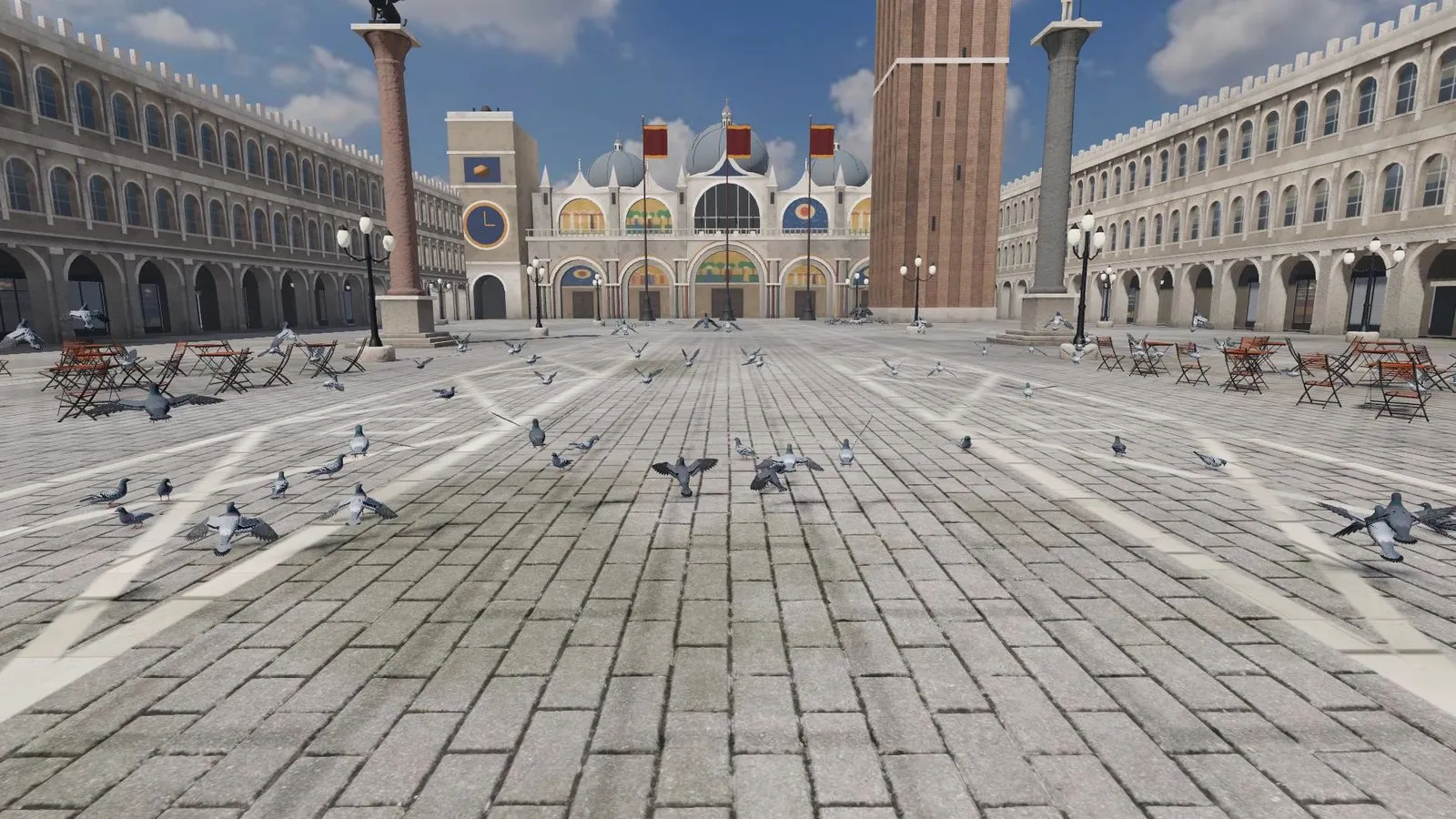
VR Phobia: Birds is a virtual reality app for Meta Quest that helps adults face a fear of birds one small step at a time. I had wanted to build it since 2021; it finally happened in a little over 24 hours of work with Claude Code. This is the making of: why I believe it can help, how the birds and places were built, and what I learned.
VR Phobia is a graded-exposure tool for adults, ideally used with the support of a professional. Its clinical effectiveness has not been evaluated: it is neither a diagnosis nor a medical treatment.
Why build a VR app for the fear of birds?
My wife is afraid of birds. Not mildly uncomfortable: properly afraid, the kind of fear that makes you cross the street when a pigeon walks by, that spoils a café terrace or a walk on the beach. In 2021, when I bought my first headset, an Oculus Quest, I thought: this is exactly what virtual reality is for. You could approach a bird one step at a time, at your own pace, knowing you can stop everything with one gesture.
The idea stayed at the back of my mind for five years. It meant modelling believable birds, animating them, building places, designing a progression that holds up, an interface made for VR, and keeping all of it running at 72 frames per second on a standalone headset. Far too much for an evening project.
What does the research say about exposure in VR?
Specific phobias are common: about 7% of adults across 22 countries have one at some point in their lives, usually starting in childhood (Wardenaar et al., Psychological Medicine, 2017). The reference treatment is gradual exposure, the core of cognitive behavioural therapy: you approach what you fear in small steps, stay long enough to learn that what you dreaded does not happen, repeat in varied situations, then take it into real life. Work on inhibitory learning by Michelle Craske and colleagues explains what matters most: not waiting for the fear to vanish, but acting despite it and testing your expectations. Exposure can even fit into one long session, as in Lars-Göran Öst’s one-session treatment from 1989.
Virtual reality is a good medium for it. A meta-analysis of 14 trials on specific phobias by Morina et al. (Behaviour Research and Therapy, 2015) found that VR exposure improved what people could actually do in real life, with no significant difference from real-life exposure after treatment or at follow-up. Automated programs go further:
- in 2018, Daniel Freeman’s team in Oxford tested a fully automated VR therapy for fear of heights, guided by a virtual coach, in a randomised trial of 100 adults published in The Lancet Psychiatry: about six 30-minute sessions over two weeks produced a very large reduction in fear, still present four weeks later;
- in 2021, the Easy Heights smartphone VR app tested by Bentz et al. (npj Digital Medicine) improved real-life behaviour on a lookout tower after six 30-minute sessions at home, while a single one-hour session did not.
There is also a small study close to our idea: in Maskey et al. (PLoS One, 2014), nine autistic children, one of them afraid of pigeons, were gradually exposed to their feared situation in an immersive room over four short sessions; eight of the nine could then face it.
An honest caveat: these studies are mostly about heights, spiders and flying. Applying them to birds is a reasonable hypothesis, not a result. VR Phobia has not been evaluated yet. I wrote a longer, sourced overview in Why virtual reality works for phobias, and a practical guide: How to overcome ornithophobia.
Why VR suits the fear of birds in particular
What frightens people about birds is less the still bird than the unpredictable: the sudden flap of wings, the take-off towards you, the whole flock lifting off at once. In real life you control none of that. In VR, each variable can be set on its own: distance, number, movement, sound, flight, and even the warning (“a take-off in 3 seconds”) before it is removed.
That’s what the app does:
- only one thing changes from one level to the next, over 51 short levels in 11 chapters (see the path);
- the birds behave like real birds: they notice you, step aside, get used to you and jostle over food, so what you learn looks like what you’ll meet outside;
- the exit is always yours: squeeze both triggers and you are by a calm lake; a finished level always counts, even if you were scared;
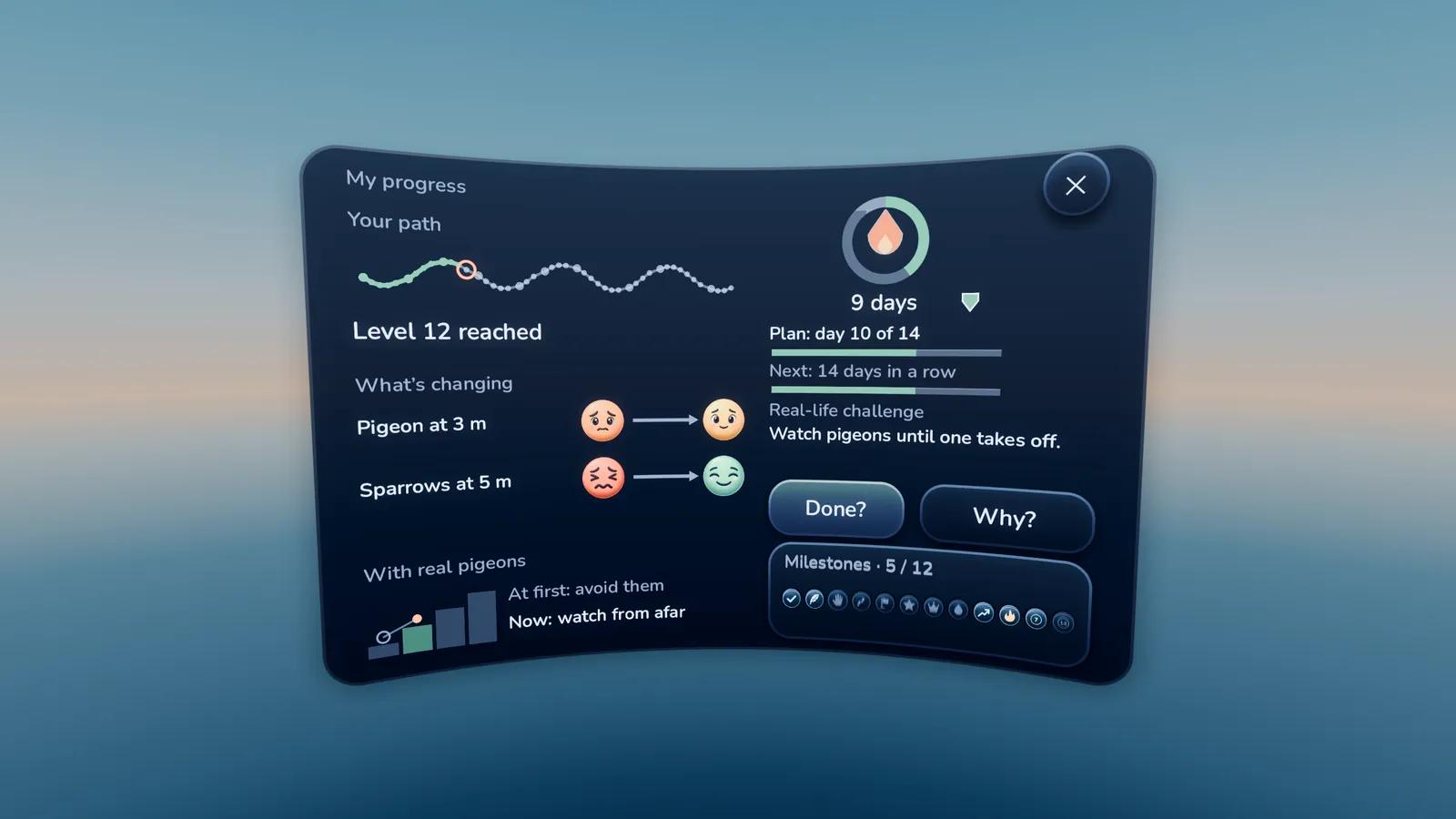
- real life is part of the programme: once a week, a question about what you managed with real pigeons, and a small real-life challenge matched to your level.
VR also removes the biggest practical obstacle of real-life exposure: you have to find birds, at the right distance, and be able to do it again. Here, the pigeon is there every evening, five metres away, waiting until you’re ready.
A first attempt that didn’t work
On September 15 I tried with another coding agent. In one afternoon it produced a playable prototype, called “Envol”: a low-poly garden, a very simple pigeon, flat 2D menu panels.
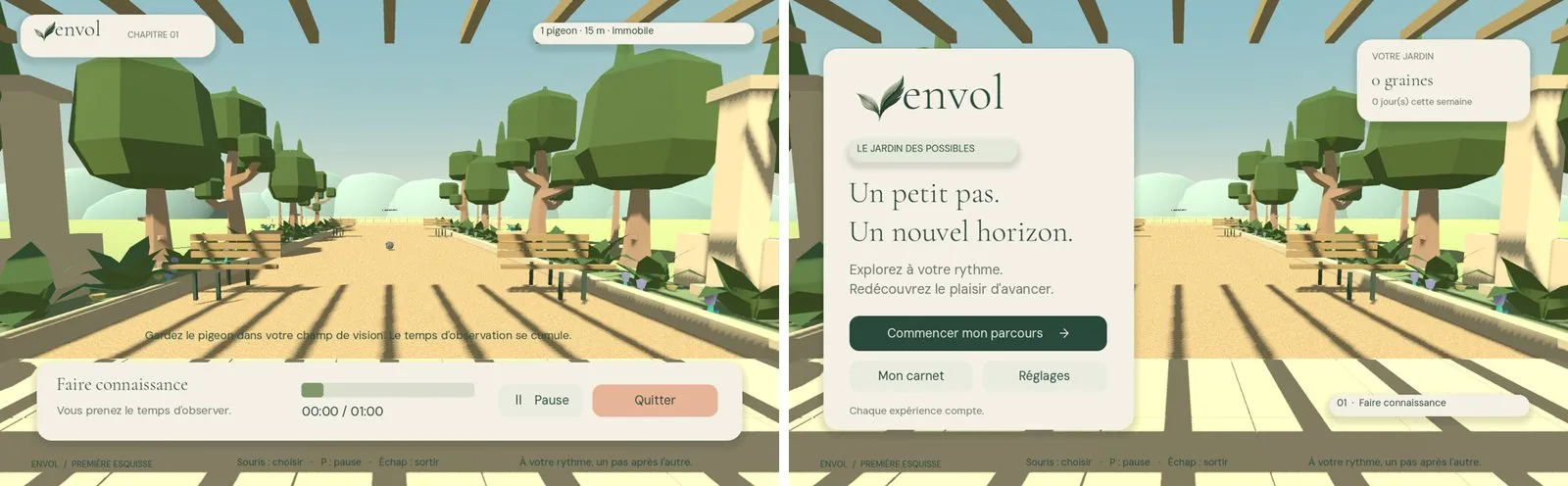
Looking at it again two weeks later, my verdict fit in one sentence: it doesn’t look like anything. No believable bird, no real progression, a website interface dropped into a 3D world. For a phobia that’s a deal-breaker: if the bird isn’t believable, the exposure is useless.
How it was built with Claude Code in about 24 hours
On September 30 at 4 pm I opened Claude Code with Claude Opus 5.5 and gave it the product brief I had written from the research, with three requests: a realistic pigeon with all its animations, real 3D environments, and progressive levels that follow the brief.
What made the difference wasn’t only the code, it was the method:
- A technical contract first: the API of a bird, the contract of a scene, the format of a level. Everything else plugged into it.
- Agents in parallel: separate workers for the birds, the environments, the sounds and the interface, each in its own copy of the repository, merged and re-tested.
- Tests everywhere: more than 3,300 automatic checks, run in all six languages, from level logic to layout and frame times.
- The headset in the loop: at every iteration, build, install on the Quest, play, read the frame rate live, and turn blunt feedback (“the hands are weird”, “the pigeons fly through a building”) into verified fixes.
In numbers: 104 commits between September 30 and the end of October 1, around 15,000 lines of GDScript for the app, 4,700 lines of tests and 15,000 lines of tools.
Birds modelled by code, not downloaded
I wanted birds as believable as good hand-made models, with clear rights and every animation a level needs. So the birds are built from scratch by a Blender pipeline written in Python: a lofted body, one bone per feather so the wings fold cleanly, plumage painted by code, and more than twenty animations per species (walking, pecking, preening, cooing, taking off, flying, landing), with feet that stay planted.
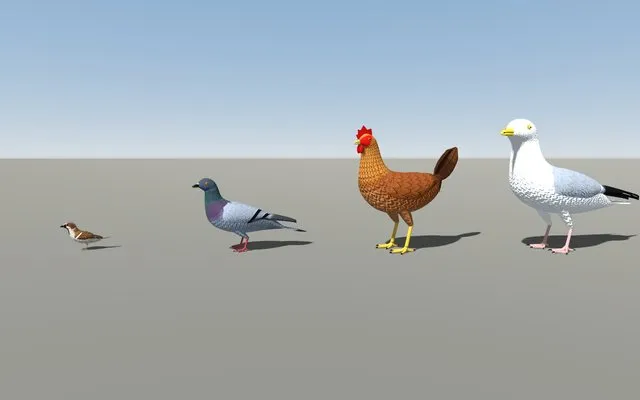
One shared skeleton gives four species, sparrow, pigeon, hen and gull, each with plumage variants.
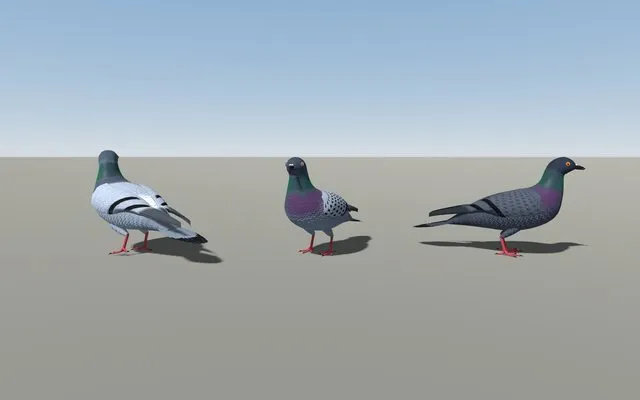
Behaviour matters as much as looks. Birds react to how fast you approach, get used to you if you stay calm, come for the food you throw, and never walk through each other. Their flights avoid buildings. On the great square, a crowd of 60 pigeons lives in small groups. The sounds are real recordings, public domain or Creative Commons, all credited.
Places and a ladder of 51 levels
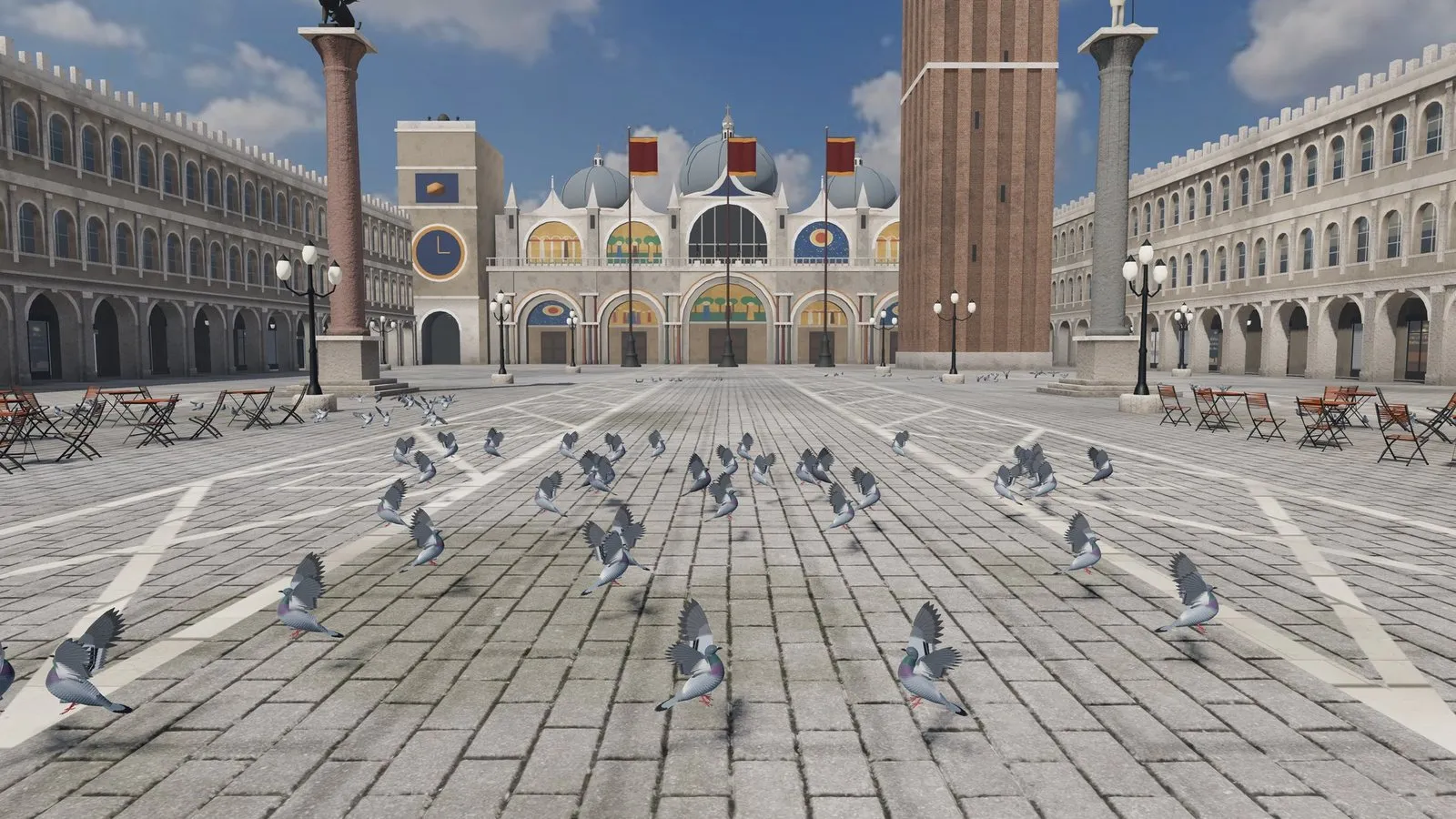
The places are built by Blender scripts too, then lit with baked lighting to stay smooth on the headset: a park, a small town square, a great Venetian-style square, a beach, a farmyard with a hen run, a glasshouse aviary, and a calm studio.
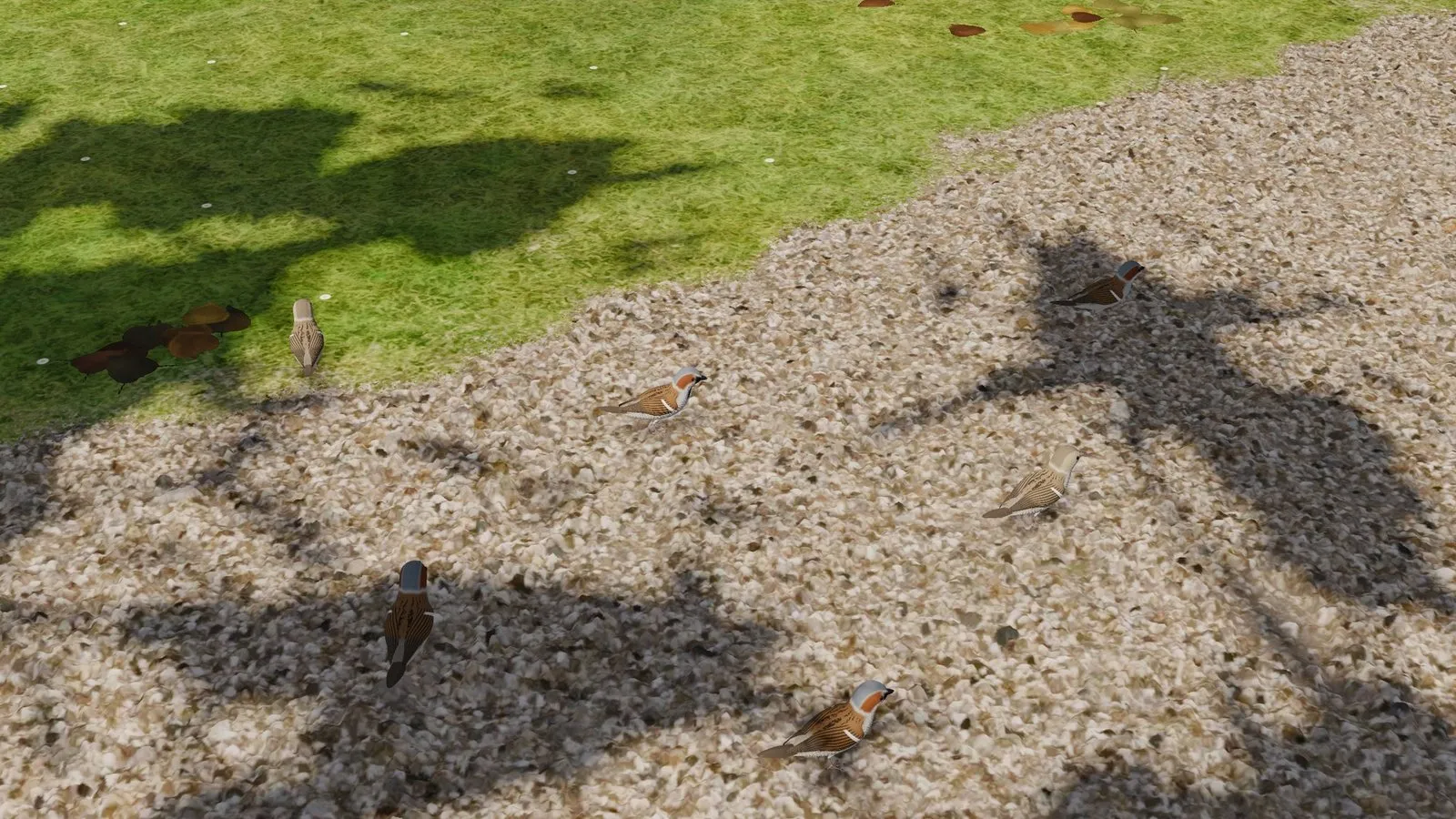
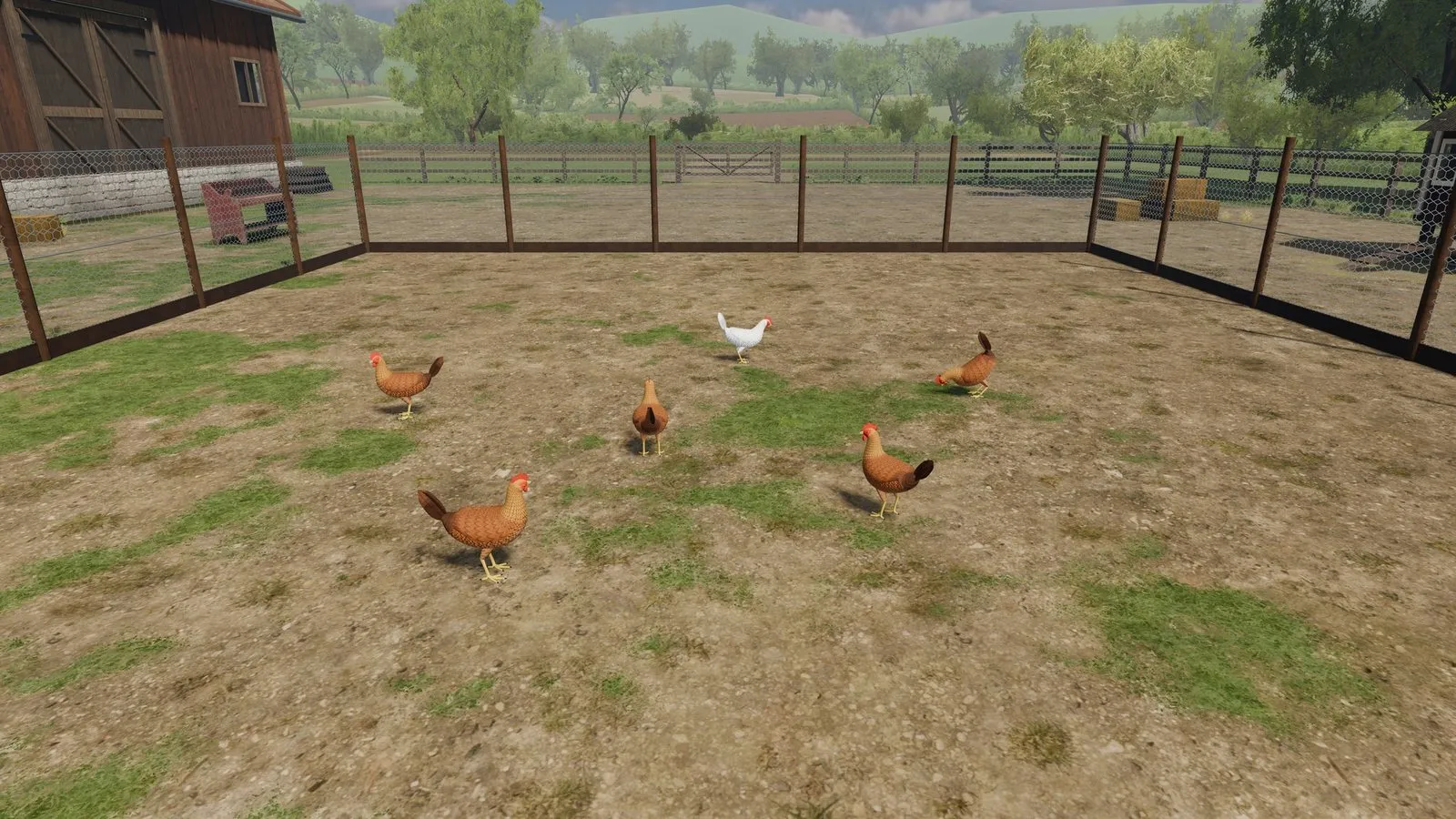
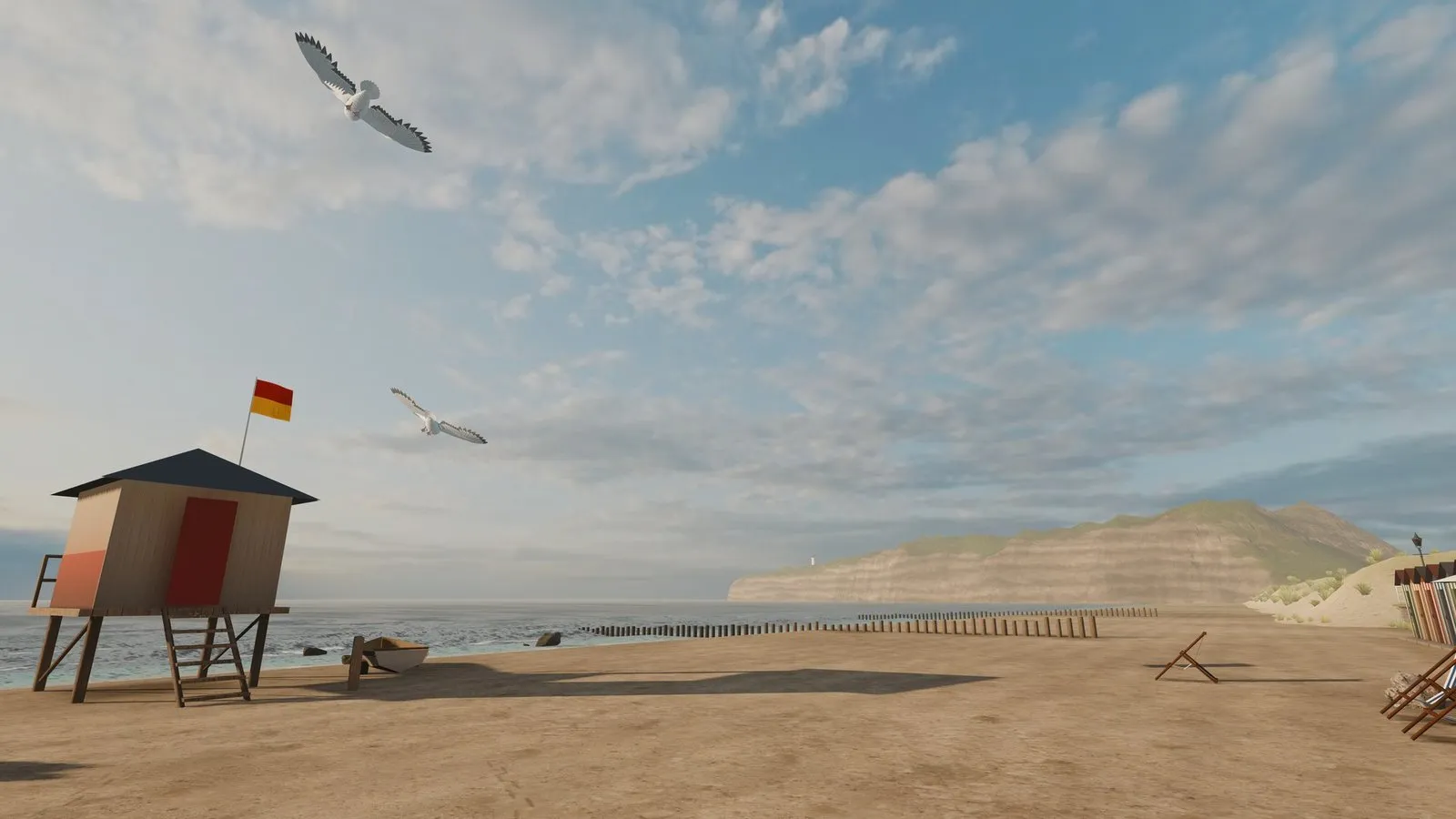
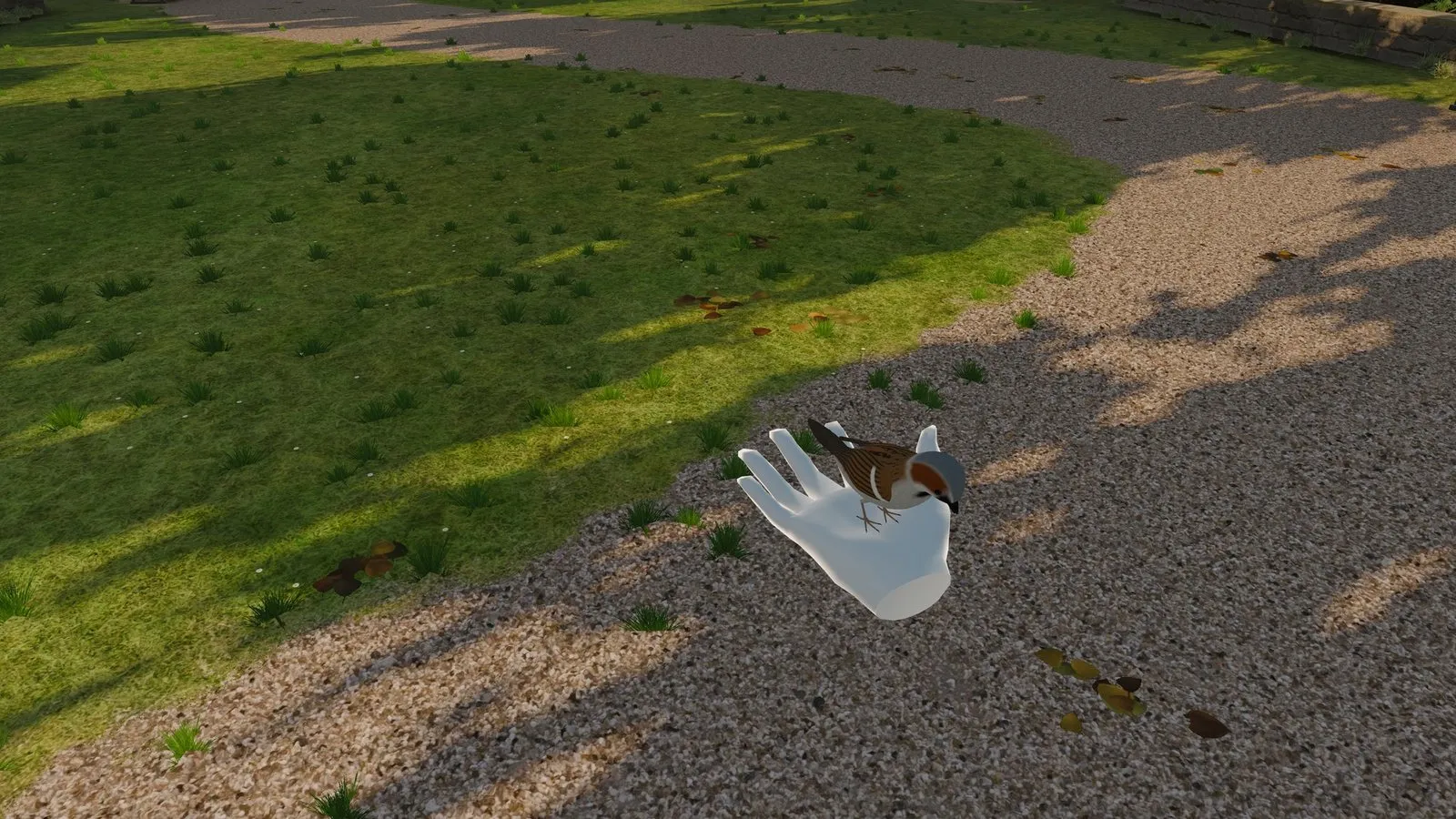
Each level changes only one thing at a time. The last chapter is the one closest to my heart: holding out your hand, palm up, and letting a sparrow land on it.
And near the top of the ladder, the great square lifting off all around you.
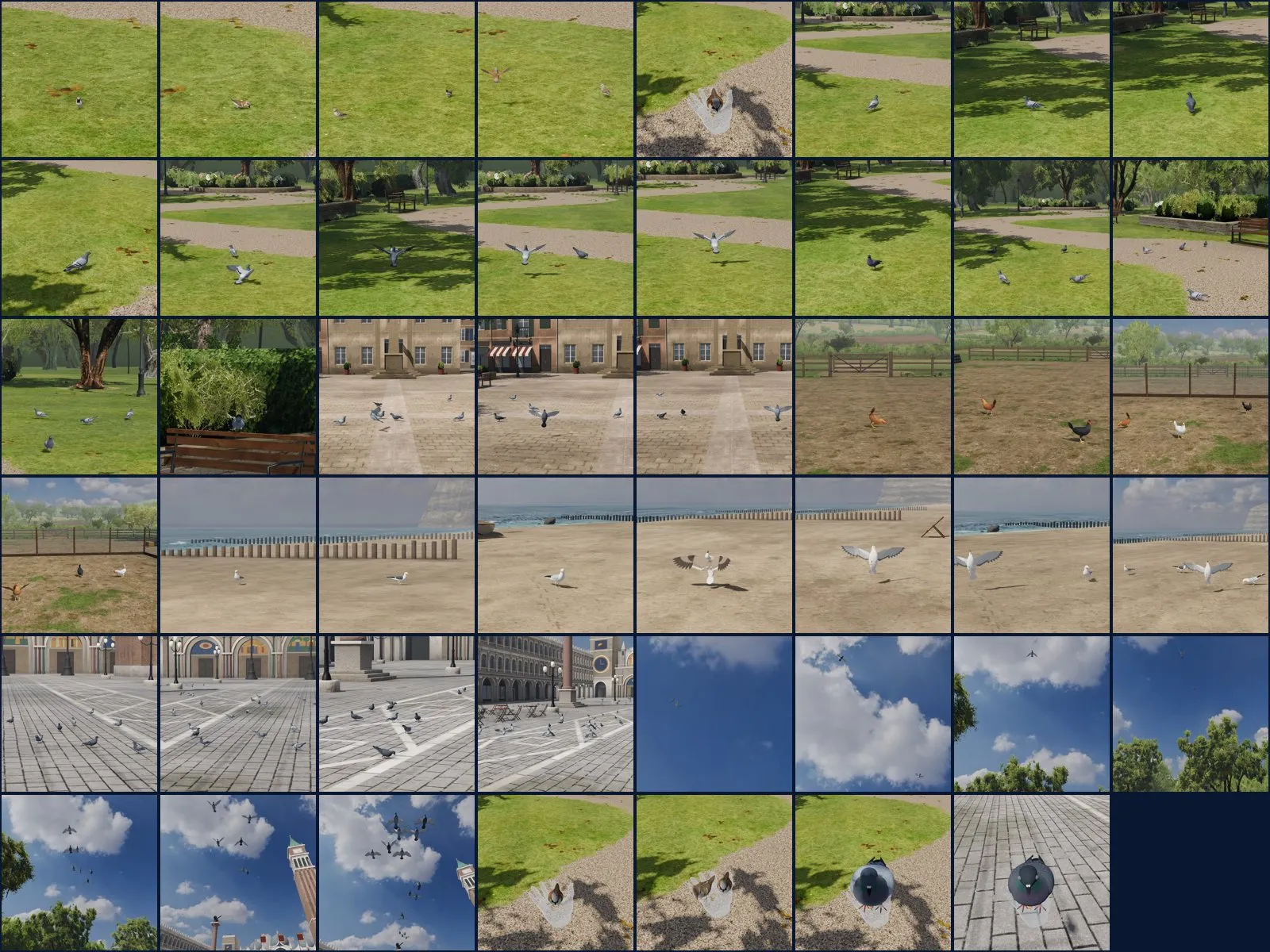
Each level has its own preview, a picture and a four-second clip rendered automatically from the game.
An interface designed for VR, with a way out
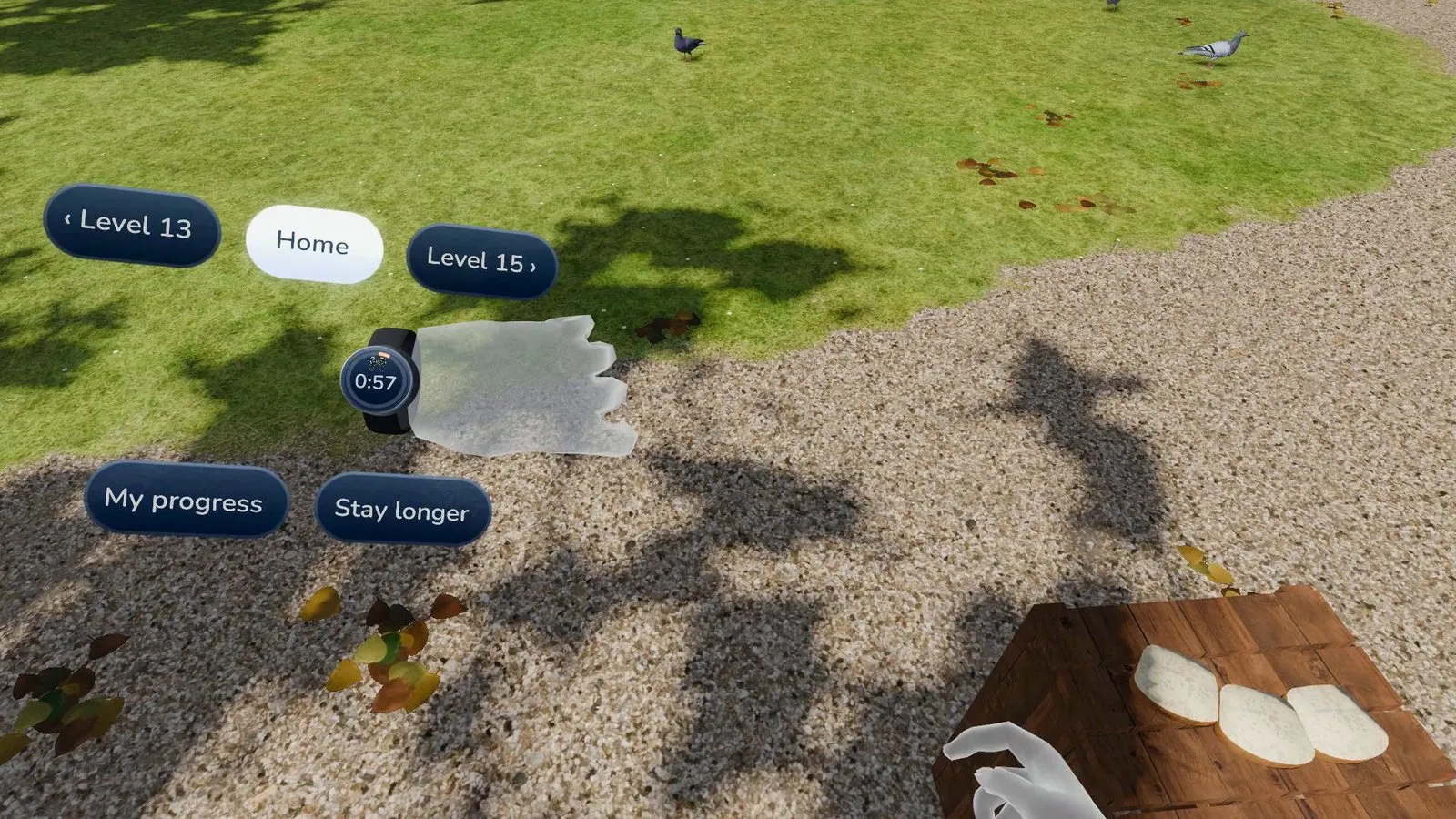
My first feedback was harsh: too many menus, flat panels. We ended up with three states only: the ribbon of levels, the level, the safe place.
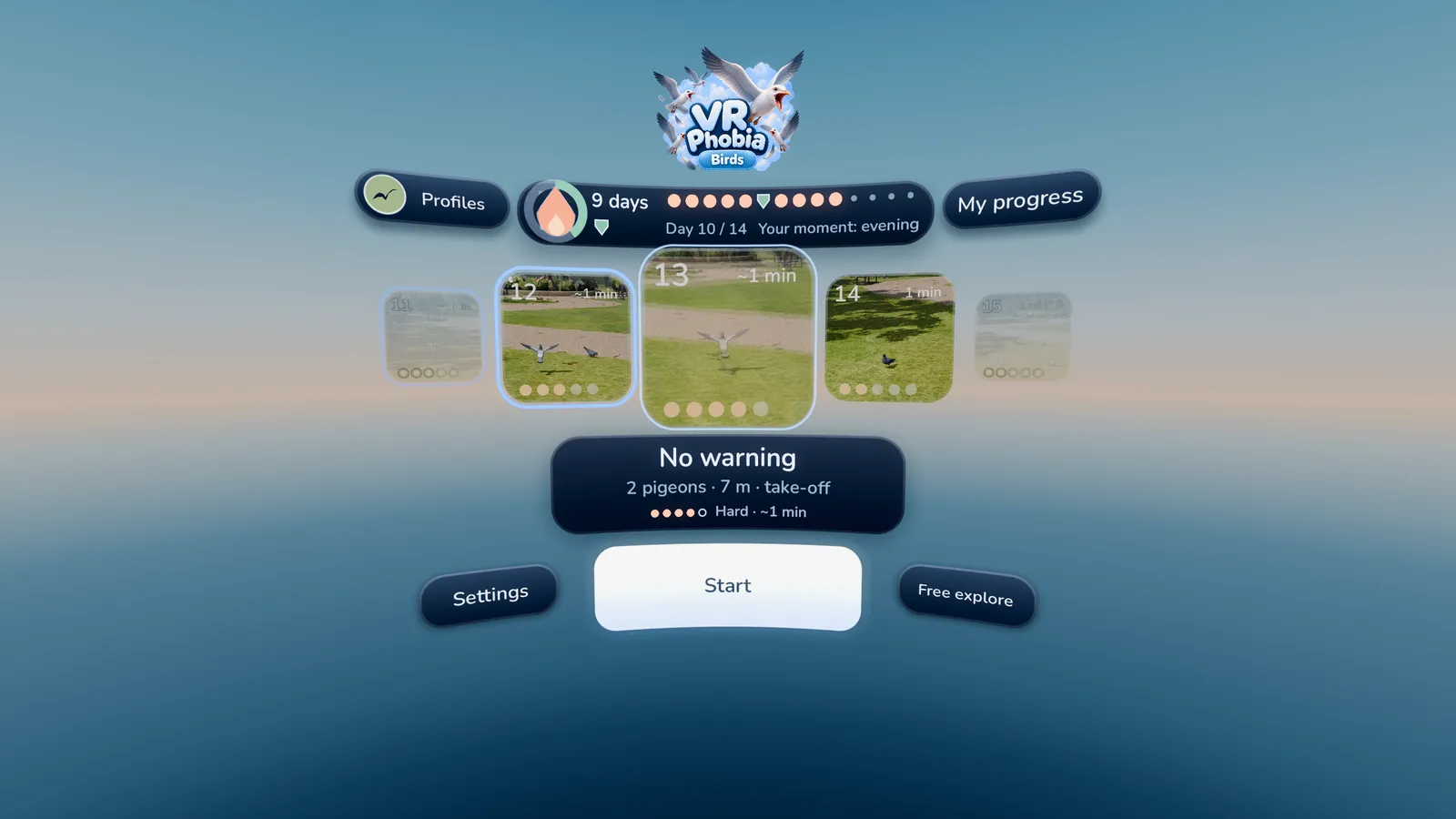
- Glass bubbles that float and react to the pointer, with one short line of instruction.
- A watch on the left wrist with the time left and a few shortcuts.
- Translucent hands, with controllers or bare hands: point and pinch from afar, or touch bubbles within reach.
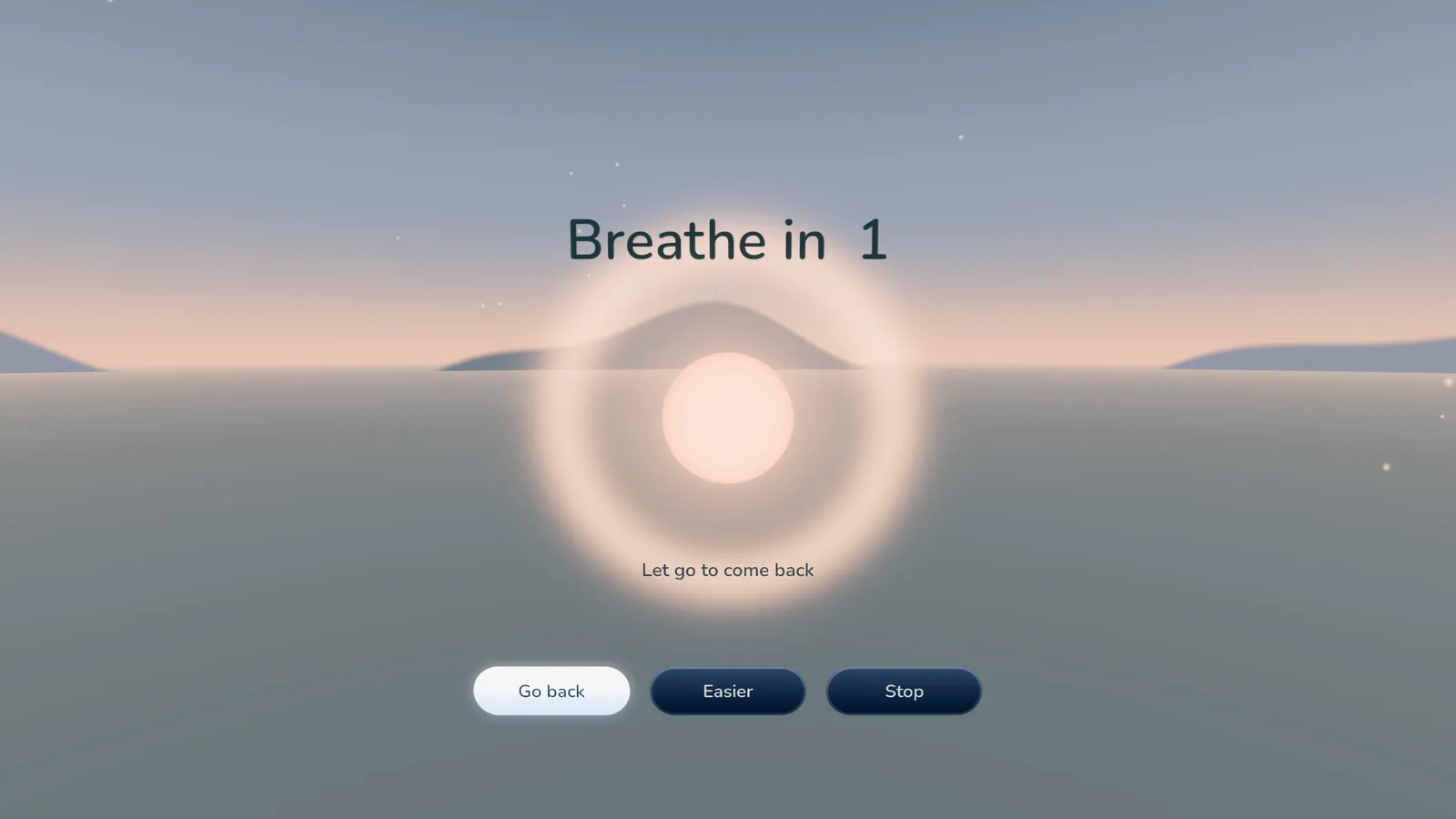
The most important part is the safe place. At any moment, squeeze both triggers (or both fists) and the level fades into a lake at dusk, with soft music and a breathing guide.
After each level, one optional question: how did it feel? The app suggests what’s next: further on, the same again, or a little gentler. A finished level always counts.
The details that make it a real app
- 72 frames per second on Quest, with baked lighting, foveated rendering and background loading so head tracking never freezes.
- Six languages: English, French, German, Spanish, Italian and Brazilian Portuguese.
- Several profiles on one headset, for a family or a therapist and their clients.
- Private by default: progress stays on the headset, and anonymous statistics are opt-in.
What I take away from it
The difference between the two attempts wasn’t typing speed. The first agent wrote code that ran. Claude held a whole project together: a contract, an architecture that survived constant change, tests that caught regressions before I did, and the ability to turn vague feedback into a precise cause and a verified fix.
The headset is the judge. Many things that were right on screen were wrong in VR: a menu half sunk into the floor, hands too transparent, a watch you could read backwards. Every session in the headset moved the app forward more than any code review.
What’s left, honestly: testing with real people who have the phobia, starting with my wife, and ideally with professionals; proofreading the translations; finishing the PC VR version; and publishing on Meta Quest. After birds, the same engine is meant for one app per fear: spiders, heights, closed spaces and snakes are the next ideas on the VR Phobia family page.
FAQ
What is VR Phobia: Birds?
VR Phobia: Birds is a virtual reality app for Meta Quest that offers gradual exposure to birds, from a single sparrow far away in a park to a bird resting on your open hand, across 51 short levels. It is made by Romain Simon at the indiega.me studio and is coming soon.
Is VR Phobia a medical treatment?
No. It is a graded-exposure tool for adults, ideally used with the support of a professional. Its clinical effectiveness has not been evaluated, and it is neither a diagnosis nor a medical treatment.
Which headsets will it run on?
Meta Quest 2, 3, 3S and Pro first, then PC VR through SteamVR.
How long did it take to build?
The current version was built in a little over 24 hours of work with Claude Code and Claude Opus 5.5, starting from a research-based product brief, after a first prototype with another agent that did not reach the quality needed.
Why does the bird need to look realistic?
Exposure works by learning that what you fear does not happen. If the bird isn’t believable, there is little to learn, so the birds are modelled with real anatomy, behaviour and sounds.
Sources
- Wardenaar KJ, Lim CCW, Al-Hamzawi AO, et al. The cross-national epidemiology of specific phobia in the World Mental Health Surveys. Psychological Medicine. 2017;47(10):1744–1760. doi:10.1017/S0033291717000174
- Craske MG, Treanor M, Conway CC, Zbozinek T, Vervliet B. Maximizing exposure therapy: an inhibitory learning approach. Behaviour Research and Therapy. 2014;58:10–23. doi:10.1016/j.brat.2014.04.006
- Öst LG. One-session treatment for specific phobias. Behaviour Research and Therapy. 1989;27(1):1–7. doi:10.1016/0005-7967(89)90113-7
- Morina N, Ijntema H, Meyerbröker K, Emmelkamp PMG. Can virtual reality exposure therapy gains be generalized to real-life? A meta-analysis of studies applying behavioral assessments. Behaviour Research and Therapy. 2015;74:18–24. doi:10.1016/j.brat.2015.08.010
- Freeman D, Haselton P, Freeman J, et al. Automated psychological therapy using immersive virtual reality for treatment of fear of heights: a single-blind, parallel-group, randomised controlled trial. The Lancet Psychiatry. 2018;5(8):625–632. doi:10.1016/S2215-0366(18)30226-8
- Bentz D, Wang N, Ibach MK, et al. Effectiveness of a stand-alone, smartphone-based virtual reality exposure app to reduce fear of heights in real-life: a randomized trial. npj Digital Medicine. 2021;4:16. doi:10.1038/s41746-021-00387-7
- Maskey M, Lowry J, Rodgers J, McConachie H, Parr JR. Reducing specific phobia/fear in young people with autism spectrum disorders (ASDs) through a virtual reality environment intervention. PLoS One. 2014;9(7):e100374. doi:10.1371/journal.pone.0100374
Keep reading
 Acrophobia (fear of heights): meaning, vertigo, causes, how common it is and how to overcome itAcrophobia is the fear of heights, the most common specific phobia in some surveys. What the word means, how it differs from vertigo, symptoms, causes, how common it is, a quick self-check, and how to overcome it.
 Arachnophobia (fear of spiders): meaning, causes, how common it is and how to overcome itArachnophobia is the fear of spiders, one of the most common specific phobias. What the word means, how to pronounce it, symptoms, causes, how common it is, a quick self-check, and how to overcome it.
 Claustrophobia (fear of enclosed spaces): meaning, symptoms, causes and how to overcome itClaustrophobia is the fear of enclosed spaces such as lifts, tunnels, crowded trains and MRI scanners. What the word means, how to pronounce it, symptoms, causes, how common it is, a quick self-check, and how to overcome it.