Out now



Coming soon
Early builds





In development

10 games by Romain SimonStudio blogThe VR Phobia family
Why virtual reality works for phobias: what the research says
On this page
- What is a specific phobia?
- How does exposure therapy work?
- Does VR exposure therapy work?
- Do the gains in VR carry over to real life?
- Can I do VR exposure therapy at home on my own?
- How many sessions does VR exposure take?
- Why do people choose VR over real-life exposure?
- Is VR exposure therapy safe? What about cybersickness?
- What are the limits of the evidence?
- When should I see a professional?
- FAQ

Virtual reality works for phobias because it delivers the same thing that makes classic treatment work: gradual, repeated exposure to what you fear, in a form you can control. Meta-analyses of randomised trials find that VR exposure therapy clearly beats waiting lists, performs about as well as real-life exposure for specific phobias, and that the gains carry over to real situations. The evidence is strongest for heights, spiders and flying; it is thin, or absent, for less common fears such as birds.
This article summarises published research for general information. It is not medical advice. If a fear is affecting your life, talk to a doctor or a qualified therapist.
What is a specific phobia?
A specific phobia is an intense, lasting fear of a particular object or situation (an animal, heights, flying, needles, blood) that leads people to avoid it, out of proportion to the actual danger. Across 25 surveys in 22 countries, about 7.4% of adults had a specific phobia at some point in their lives; it usually starts in childhood, with a median onset at age 8, and only about a quarter of people affected in the past year had received any treatment (Wardenaar et al., Psychological Medicine, 2017). In the United States, the estimated lifetime prevalence is 12.5% (NIMH).
The NHS lists physical symptoms such as dizziness, a pounding heartbeat, chest tightness, nausea and trembling, alongside an intense fear of losing control.
How does exposure therapy work?
Exposure therapy works by helping you learn, through experience, that what you fear is safer than your fear predicts. You approach the feared thing step by step, stay with it, and repeat until the new learning (“I can stand near a pigeon and nothing bad happens”) competes with the old fear.
Modern research describes this as inhibitory learning: the old fear memory isn’t erased, a new and safer memory is built on top of it, and the goal is to make that new memory strong and easy to retrieve. In their practical guide, Craske et al. (Behaviour Research and Therapy, 2014) recommend:
- testing your expectations, noticing that the feared outcome didn’t happen;
- variability: different places, distances, movements and times of day;
- dropping safety signals gradually, such as looking away or holding your breath;
- practising in several contexts, including real life.
Exposure can be spread over many sessions or concentrated into one long session, as in the one-session treatment described by Öst (Behaviour Research and Therapy, 1989). A 2022 meta-analysis of 85 study groups found no difference in effectiveness between single-session and multi-session real-life exposure for specific phobias, with the single session more time-efficient (Odgers et al., Behaviour Research and Therapy).
Does VR exposure therapy work?
Yes, for specific phobias the evidence is consistent and fairly strong. VR exposure therapy (often called VRET) produces large improvements compared with doing nothing, and results similar to exposure in real life.
- An early meta-analysis of 13 studies found a large effect of VR exposure compared with control conditions, and no advantage for real-life exposure over VR (Powers and Emmelkamp, Journal of Anxiety Disorders, 2008).
- A 2019 meta-analysis of 30 randomised controlled trials, with 1,057 participants and 14 trials on specific phobias, found a large effect compared with waiting lists and no significant difference between VR and real-life exposure (Carl et al., Journal of Anxiety Disorders).
- Another 2019 meta-analysis, limited to trials comparing VR directly with real-life exposure, found no evidence that VR is significantly less effective for specific phobia or agoraphobia; for social anxiety, real-life exposure did better (Wechsler et al., Frontiers in Psychology).
Do the gains in VR carry over to real life?
They do, according to behavioural tests in which people actually approach the real thing. A meta-analysis of 14 trials on specific phobias measured what participants could do in real situations, not just how they felt: after VR exposure, people did much better than before treatment and than people on a waiting list, with no significant difference from real-life exposure after treatment or at follow-up (Morina et al., Behaviour Research and Therapy, 2015).
VR is a rehearsal space: the real test is the street, the plane or the balcony. Good programmes therefore add real-life practice once the virtual steps feel manageable.
Can I do VR exposure therapy at home on my own?
Trials suggest that self-guided VR can help for some fears, at least the fear of heights, but it was tested in research settings and is not a substitute for professional care when a phobia is severe.
- Automated VR therapy. In Oxford, 100 adults with a fear of heights were randomised to an automated program guided by a virtual coach, with no therapist in the room, or to usual care. After about six 30-minute sessions over two weeks, fear of heights dropped far more in the VR group, the benefit held at four weeks, and no adverse events were reported (Freeman et al., The Lancet Psychiatry, 2018).
- Smartphone VR at home. In the Netherlands, 193 adults used ZeroPhobia, a fully self-guided app with cheap cardboard goggles, over three weeks. Fear of heights fell much more than in a waiting-list group, and 77% of those who started completed the programme (Donker et al., JAMA Psychiatry, 2019).
- Easy Heights. In Switzerland, a single one-hour session of a smartphone VR app did not change behaviour on a real lookout tower, but six additional 30-minute sessions at home did (Bentz et al., npj Digital Medicine, 2021).
The Easy Heights result is a useful reminder: one session alone may not be enough; repetition matters. For a practical plan, see how to overcome the fear of heights.
How many sessions does VR exposure take?
There is no single number, but the self-guided trials above used roughly two to three hours of exposure over two to three weeks, in sessions of about 30 minutes. Therapist-led one-session treatments are longer and more intensive. The early meta-analysis by Powers and Emmelkamp also found a trend towards larger effects with more VR sessions.
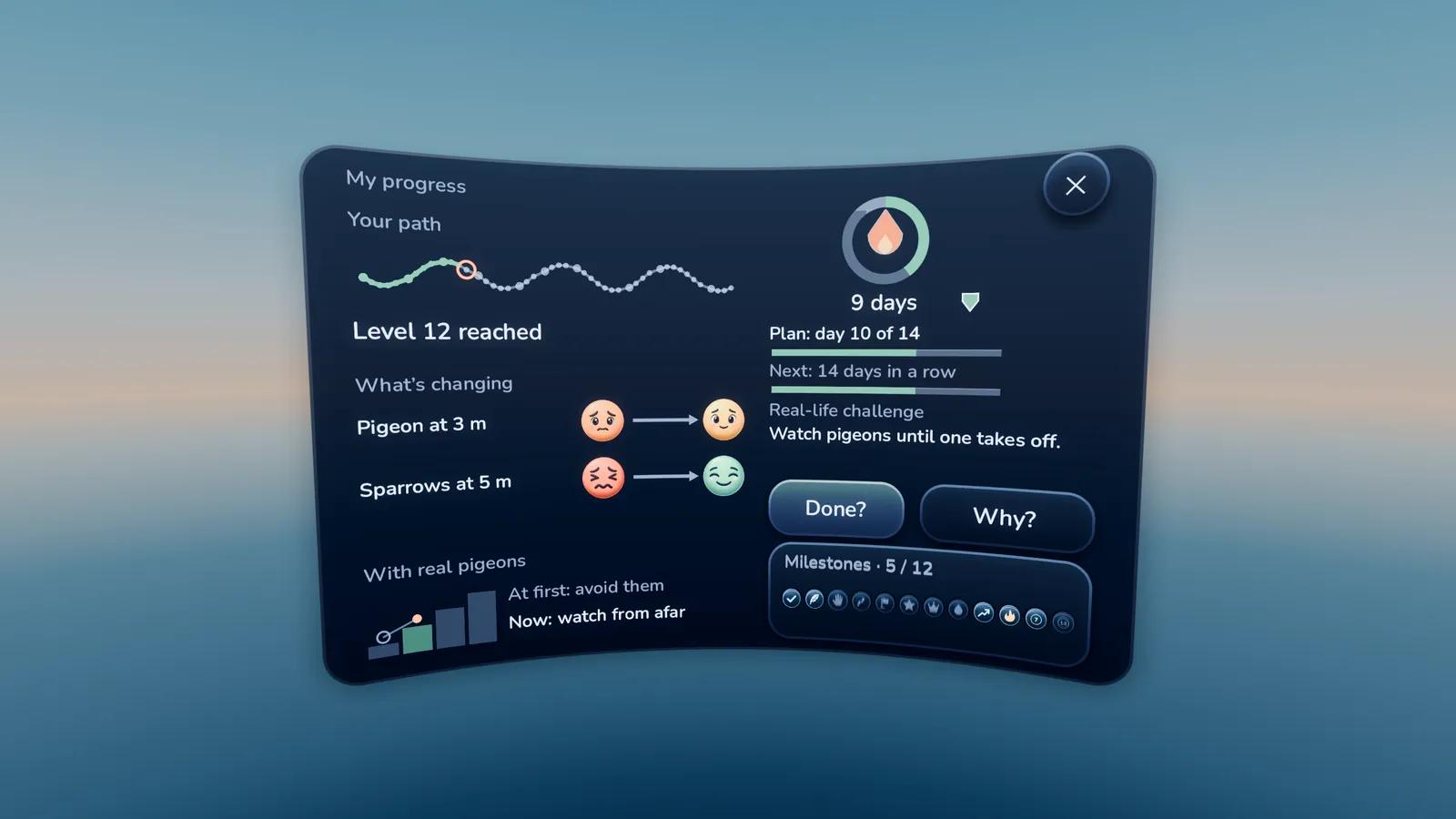
A practical rhythm many programmes use: short sessions several times a week, stopping when tired, then occasional refresher sessions later. VR Phobia: Birds, for example, suggests 15 to 30 minutes a day, four to five days a week, for two to three weeks.
Why do people choose VR over real-life exposure?
Because it feels more approachable and is easier to organise. In a survey of 150 people with specific phobias, 76% preferred VR exposure to real-life exposure, and the refusal rate was much lower for VR (3%) than for real-life exposure (27%) (Garcia-Palacios et al., CyberPsychology & Behavior, 2007).
VR also solves practical problems: you don’t need to find a bird, a spider or a high bridge on demand, you can repeat exactly the same step, and you can stop at any moment. Once people are in treatment, though, drop-out is similar: across 46 studies, about 16% of participants left VR exposure early, a rate comparable to real-life exposure, and programmes with practice between sessions kept people better (Benbow and Anderson, Journal of Anxiety Disorders, 2019).
Is VR exposure therapy safe? What about cybersickness?
For most adults it is well tolerated, but it can cause temporary side effects. Headsets can trigger cybersickness: a systematic review found side effects reported more often with head-mounted displays than with desktop systems, mainly disorientation, then nausea and eye strain (Simón-Vicente et al., Neurología, 2024). Some discomfort during exposure is also expected, since facing a fear is uncomfortable by design.
Sensible precautions: short sessions, a stable seated or standing position, no artificial camera movement, breaks at the first sign of nausea, and an easy way out. People with epilepsy, severe dizziness or a heart condition should ask a doctor first.
What are the limits of the evidence?
The research is encouraging but has clear limits:
- Most trials are small and cover a few common fears, mainly heights, spiders and flying. In the Carl et al. meta-analysis, larger studies tended to show smaller effects.
- Many fears have little or no VR research, including the fear of birds. Applying results from heights or spiders to birds is a reasonable hypothesis, not a proven result.
- Self-guided studies screened their participants: people with severe or complex anxiety, or other conditions, may need a therapist.
- Apps differ: results from one tested program don’t automatically transfer to another app.
When should I see a professional?
See a doctor or a therapist trained in cognitive behavioural therapy if your fear is affecting your daily life, if you have panic attacks, if it is getting worse, or if you also feel low or anxious most of the time; the NHS advises seeing a GP when a phobia affects your life. A therapist can guide the exposure, adjust the pace, and combine VR with real-life steps. Self-help tools work best as a complement.
For birds specifically, read Ornithophobia: meaning, causes and how common it is and the step-by-step guide How to overcome ornithophobia.
FAQ
Does virtual reality really help with phobias?
For specific phobias, yes: meta-analyses of randomised trials show large improvements compared with no treatment and results similar to real-life exposure, with gains that carry over to real situations.
Is VR exposure as good as real-life exposure?
For specific phobias, studies find no significant difference between VR and real-life exposure, either right after treatment or at follow-up. For social anxiety, real-life exposure did better in one meta-analysis.
How long does VR exposure therapy take?
Self-guided programmes for fear of heights used about two to three hours of exposure over two to three weeks, in sessions of around 30 minutes.
Can I treat a phobia with a VR app at home?
Trials show that self-guided VR apps can reduce fear of heights at home, but they were tested in research settings. If your fear is severe or affects your life, combine an app with professional support.
Does VR exposure therapy have side effects?
Some people get temporary cybersickness, mainly disorientation, nausea or eye strain, more often with headsets than with screens. Short sessions, comfortable movement and breaks reduce it.
Is there research on VR for the fear of birds?
Very little. A small study of nine autistic children by Maskey et al. included one child afraid of pigeons, who was gradually exposed in an immersive room, but there is no large trial specific to birds. Read more in Ornithophobia.
Sources
- Powers MB, Emmelkamp PMG. Virtual reality exposure therapy for anxiety disorders: a meta-analysis. Journal of Anxiety Disorders. 2008;22(3):561–569. doi:10.1016/j.janxdis.2007.04.006
- Carl E, Stein AT, Levihn-Coon A, et al. Virtual reality exposure therapy for anxiety and related disorders: a meta-analysis of randomized controlled trials. Journal of Anxiety Disorders. 2019;61:27–36. doi:10.1016/j.janxdis.2018.08.003
- Morina N, Ijntema H, Meyerbröker K, Emmelkamp PMG. Can virtual reality exposure therapy gains be generalized to real-life? A meta-analysis of studies applying behavioral assessments. Behaviour Research and Therapy. 2015;74:18–24. doi:10.1016/j.brat.2015.08.010
- Wardenaar KJ, Lim CCW, Al-Hamzawi AO, et al. The cross-national epidemiology of specific phobia in the World Mental Health Surveys. Psychological Medicine. 2017;47(10):1744–1760. doi:10.1017/S0033291717000174
- National Institute of Mental Health. Specific phobia (statistics, National Comorbidity Survey Replication). nimh.nih.gov
- NHS. Phobias: overview. nhs.uk
- Craske MG, Treanor M, Conway CC, Zbozinek T, Vervliet B. Maximizing exposure therapy: an inhibitory learning approach. Behaviour Research and Therapy. 2014;58:10–23. doi:10.1016/j.brat.2014.04.006
- Öst LG. One-session treatment for specific phobias. Behaviour Research and Therapy. 1989;27(1):1–7. doi:10.1016/0005-7967(89)90113-7
- Odgers K, Kershaw KA, Li SH, Graham BM. The relative efficacy and efficiency of single- and multi-session exposure therapies for specific phobia: a meta-analysis. Behaviour Research and Therapy. 2022;159:104203. doi:10.1016/j.brat.2022.104203
- Wechsler TF, Kümpers F, Mühlberger A. Inferiority or even superiority of virtual reality exposure therapy in phobias? A systematic review and quantitative meta-analysis on randomized controlled trials specifically comparing the efficacy of virtual reality exposure to gold standard in vivo exposure in agoraphobia, specific phobia, and social phobia. Frontiers in Psychology. 2019;10:1758. doi:10.3389/fpsyg.2019.01758
- Freeman D, Haselton P, Freeman J, et al. Automated psychological therapy using immersive virtual reality for treatment of fear of heights: a single-blind, parallel-group, randomised controlled trial. The Lancet Psychiatry. 2018;5(8):625–632. doi:10.1016/S2215-0366(18)30226-8
- Donker T, Cornelisz I, van Klaveren C, et al. Effectiveness of self-guided app-based virtual reality cognitive behavior therapy for acrophobia: a randomized clinical trial. JAMA Psychiatry. 2019;76(7):682–690. doi:10.1001/jamapsychiatry.2019.0219
- Bentz D, Wang N, Ibach MK, et al. Effectiveness of a stand-alone, smartphone-based virtual reality exposure app to reduce fear of heights in real-life: a randomized trial. npj Digital Medicine. 2021;4:16. doi:10.1038/s41746-021-00387-7
- Garcia-Palacios A, Botella C, Hoffman H, Fabregat S. Comparing acceptance and refusal rates of virtual reality exposure vs. in vivo exposure by patients with specific phobias. CyberPsychology & Behavior. 2007;10(5):722–724. doi:10.1089/cpb.2007.9962
- Benbow AA, Anderson PL. A meta-analytic examination of attrition in virtual reality exposure therapy for anxiety disorders. Journal of Anxiety Disorders. 2019;61:18–26. doi:10.1016/j.janxdis.2018.06.006
- Simón-Vicente L, Rodríguez-Cano S, Delgado-Benito V, et al. Cybersickness. A systematic literature review of adverse effects related to virtual reality. Neurología. 2024;39(8):701–709. doi:10.1016/j.nrleng.2022.04.007
- Maskey M, Lowry J, Rodgers J, McConachie H, Parr JR. Reducing specific phobia/fear in young people with autism spectrum disorders (ASDs) through a virtual reality environment intervention. PLoS One. 2014;9(7):e100374. doi:10.1371/journal.pone.0100374
Keep reading
 Acrophobia (fear of heights): meaning, vertigo, causes, how common it is and how to overcome itAcrophobia is the fear of heights, the most common specific phobia in some surveys. What the word means, how it differs from vertigo, symptoms, causes, how common it is, a quick self-check, and how to overcome it.
 Arachnophobia (fear of spiders): meaning, causes, how common it is and how to overcome itArachnophobia is the fear of spiders, one of the most common specific phobias. What the word means, how to pronounce it, symptoms, causes, how common it is, a quick self-check, and how to overcome it.
 Claustrophobia (fear of enclosed spaces): meaning, symptoms, causes and how to overcome itClaustrophobia is the fear of enclosed spaces such as lifts, tunnels, crowded trains and MRI scanners. What the word means, how to pronounce it, symptoms, causes, how common it is, a quick self-check, and how to overcome it.